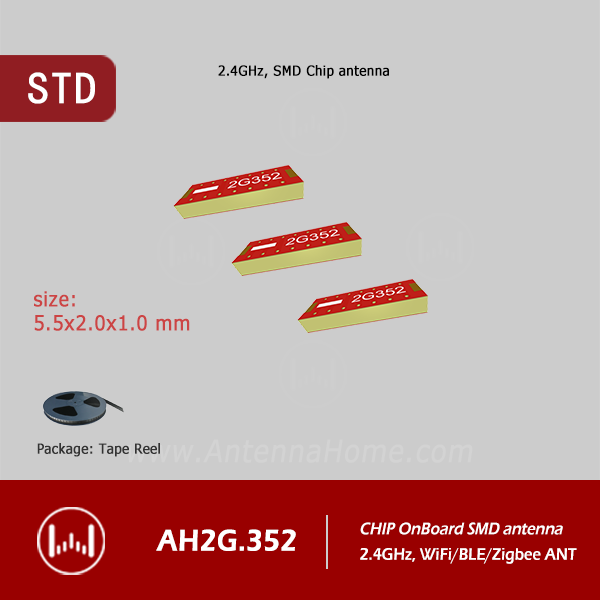
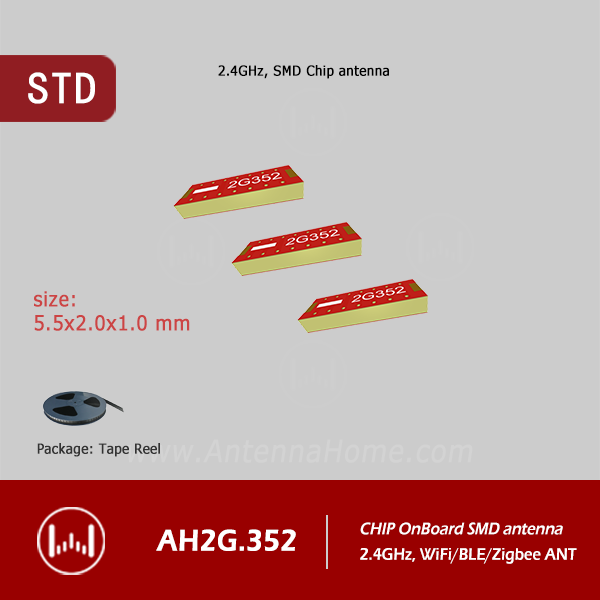
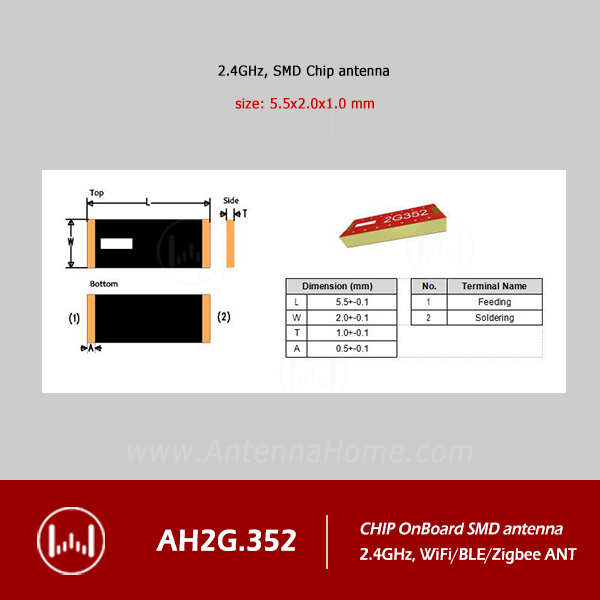
2.4GHz,SMD CHIP Antenna, WiFi/BLE/Zigbee, 5.5x2x1mm, AH2G.352 (PN AH2G.352) is a smd chip antenna operating at 2.4GHz for 4G LTE routers and gateways. The key ordering parameters are listed below. Samples, custom cable lengths and OEM branding are available on request.
Key Specifications
Key ordering specifications
| Property | Specification |
|---|
| Part Number | AH2G.352 |
|---|
| Frequency | 2.4GHz |
|---|
| Weight | 5.5 x 2.0 x 1.0 mm |
|---|
| Package | Tape Reel |
|---|
| Category | WiFi/BLE/Zigbee/2.4G Antenna |
|---|
Full electrical and mechanical datasheet on request — ask our engineers.
Frequently Asked Questions
What frequency range does AH2G.352 cover?
AH2G.352 covers 2.4GHz. If your application needs a band outside this range, we can retune the matching network for your target frequency.
How is AH2G.352 packed and shipped?
For AH2G.352, unit weight is 5.5 x 2.0 x 1.0 mm and standard packaging is Tape Reel. Bulk packing and custom labelling are available for volume orders.
What is the minimum order quantity and lead time?
Standard models ship in 7–15 working days after order confirmation; samples of in-stock models can ship within 3 days. MOQ depends on the model — contact us for the exact figure for your part number.
Can AntennaHome customize an antenna for my device?
Yes. We provide customized design including frequency tuning, connector and cable length, housing and mounting method. Send us your enclosure drawing, available ground plane size and target bands, and our RF engineers will propose a design.
What certifications and test reports are available?
Products are RoHS and REACH compliant. We operate an in-house 3D anechoic chamber and can provide VSWR, gain and radiation pattern test reports for the specific part number you order.
Further reading
- Impedance Matching and the Smith Chart: A Practical Guide for IoT Antenna Tuning — Matching moves the antenna's impedance to the 50 ohm centre of the Smith chart so power actually leaves the transmitter. In practice it is a loop: measure S11 with a VNA in the final enclosure, adjust the pi-network parts, re-measure — and expect the enclosure to be part of the
- VSWR, Return Loss and S11: What the Numbers Mean for an IoT Antenna — VSWR, return loss and S11 are three views of one defect — reflected power. VSWR 2.0 costs only 0.51 dB of mismatch loss, so the number that really matters is whether the antenna stays matched across the band in your enclosure, not whether it hits
- Wi-Fi Channel and Frequency Table: 2.4 GHz, 5 GHz, 6 GHz and Wi-Fi 7 — Centre frequencies and rules for every band Wi-Fi uses: 2.4 GHz channels 1-13 (only 1/6/11 are non-overlapping at 20 MHz), 5 GHz U-NII sub-bands with DFS, 6 GHz (Wi-Fi 6E) at 5925-7125 MHz, and Wi-Fi 7's 320 MHz
- External vs Internal Antenna: How to Choose for an IoT Device — Internal antennas win on cost, size and ruggedness; external antennas win on efficiency, bandwidth and placement freedom. The decision usually turns on three questions: is the enclosure metal, how much ground plane do you have, and can the device be oriented