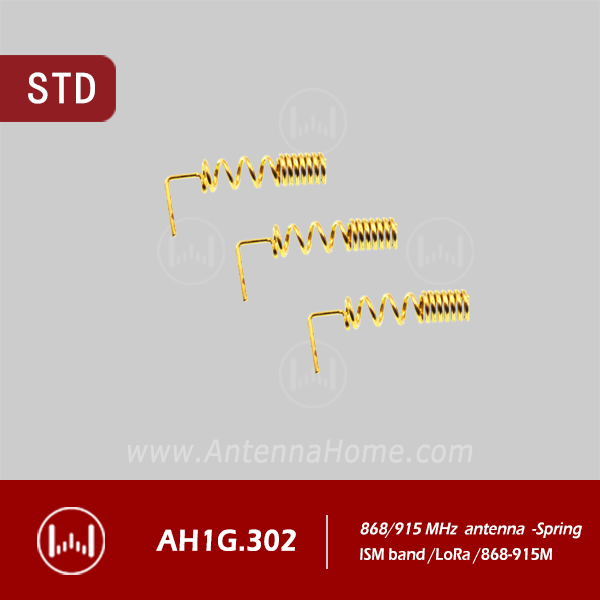
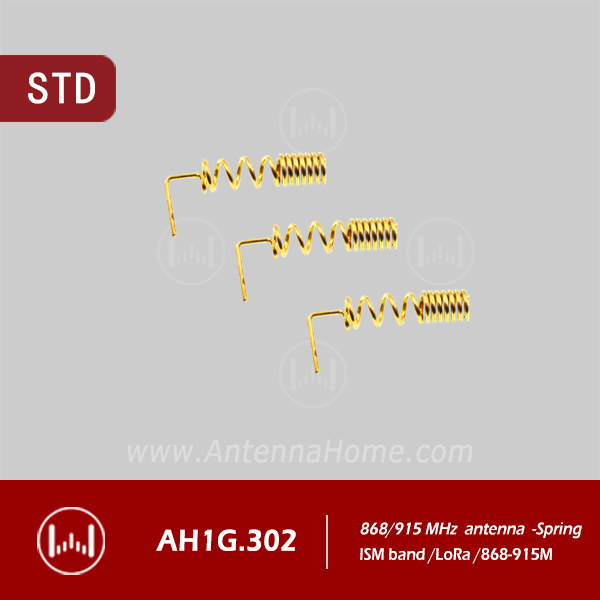
Spring DIP, 868/915M 900/1800MHz GSM, LoRa, NB-IOT antenna, AH1G.302 (PN AH1G.302) is an antenna operating at 915MHz–1.8GHz for LoRa and LPWAN nodes. The specifications below are taken from its datasheet. Samples, custom cable lengths and OEM branding are available on request.
Key Specifications
Electrical Properties
Electrical Properties
| Property | Specification |
|---|
| Frequency | 868/915 MHz,900/180MHz |
|---|
| Impedance | 50Ω |
|---|
| VSWR | ≤2.5 |
|---|
| Gain | 1.0 dBi |
|---|
| Polarization | Vertical / Omni |
|---|
Mechanical Properties
Mechanical Properties
| Property | Specification |
|---|
| Conn&Cable | / |
|---|
| Material&Color | Copper / ABS |
|---|
| Mounting | DIP |
|---|
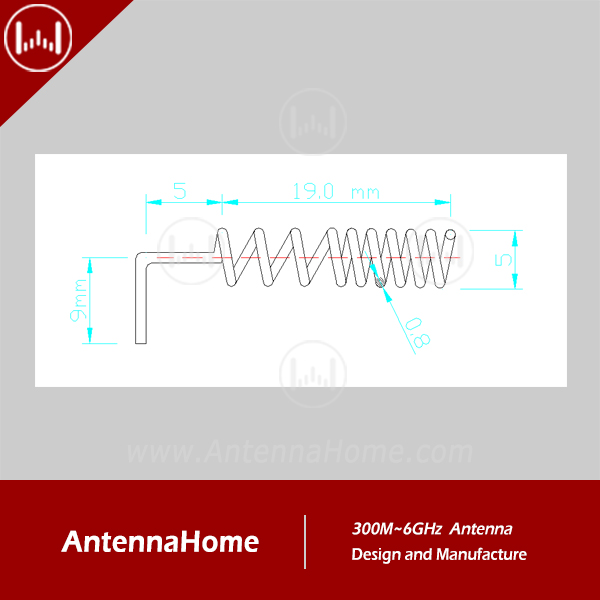
| Size | ¢5.0 ×L24.0 mm |
|---|
| Weight | 0.7 g/pcs |
|---|
| Operate Temp | -40 ~ +85 ℃ |
|---|
Frequently Asked Questions
What frequency range does AH1G.302 cover?
AH1G.302 covers 868/915M,900/1800MHz. If your application needs a band outside this range, we can retune the matching network for your target frequency.
How is AH1G.302 packed and shipped?
For AH1G.302, unit weight is 3 g/pcs and standard packaging is PP bag. Bulk packing and custom labelling are available for volume orders.
What is the minimum order quantity and lead time?
Standard models ship in 7–15 working days after order confirmation; samples of in-stock models can ship within 3 days. MOQ depends on the model — contact us for the exact figure for your part number.
Can AntennaHome customize an antenna for my device?
Yes. We provide customized design including frequency tuning, connector and cable length, housing and mounting method. Send us your enclosure drawing, available ground plane size and target bands, and our RF engineers will propose a design.
What certifications and test reports are available?
Products are RoHS and REACH compliant. We operate an in-house 3D anechoic chamber and can provide VSWR, gain and radiation pattern test reports for the specific part number you order.
Further reading
- Antenna Gain Explained: dBi vs dBd, and Why Higher Is Not Always Better — Antenna gain is directionality, not amplification. dBi = dBd + 2.15, and every 3 dB of extra gain halves the coverage angle — which is why a 3 dBi omni usually beats a 9 dBi omni on a device whose orientation you cannot
- Sub-GHz ISM and SRD Frequency Bands by Region: 433 / 868 / 915 / 470 MHz — A region-by-region table of the license-free sub-GHz bands used by LoRa, ISM and SRD devices: 433 MHz (ITU Region 1 only), 868 MHz (Europe), 902-928 MHz (US), 470-510 MHz (China), 920 MHz (Japan), plus the LoRaWAN regional channel
- LoRa Antenna Frequency: 433 MHz vs 868 MHz vs 915 MHz vs 470 MHz — The choice is regulatory first and technical second: 868 MHz for Europe, 915 MHz for North America and Australia, 470 MHz for China, 433 MHz where ITU Region 1 permits it. Propagation differences inside 433-928 MHz are small compared with duty cycle and EIRP
- Antenna Efficiency, Radiation Pattern and Near Field: The Numbers That Decide Range — Efficiency, not gain, sets how far a link reaches. Total efficiency folds in mismatch loss, the radiation pattern shows where the power actually goes, and the 2D²/λ far-field boundary decides whether your range test measured anything